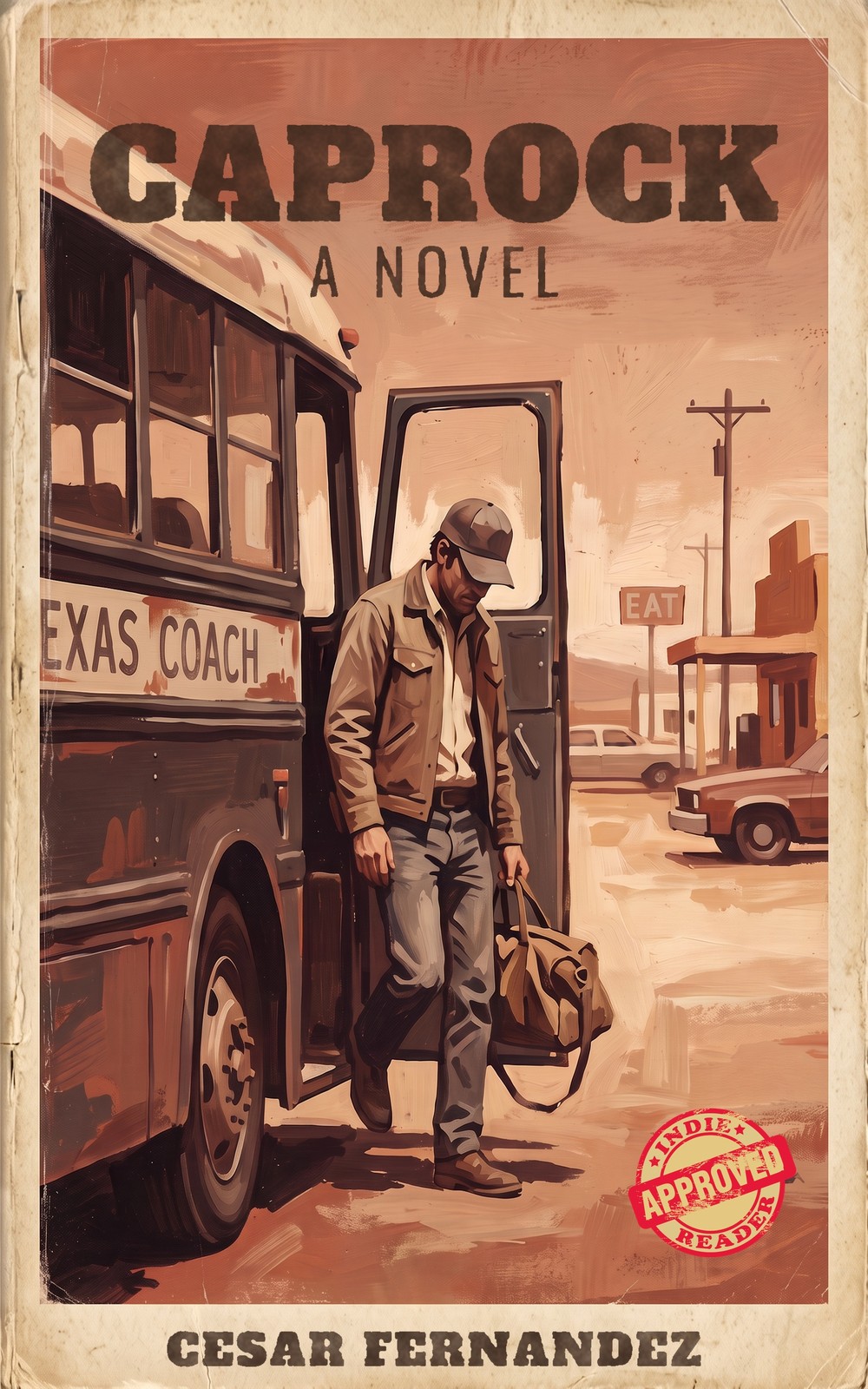
A Novel
CAPROCK
Richard Lang rolled into Caprock four years ago with a checkbook and a quiet smile. Liam Cooper stepped off the Monday bus carrying everything he owned in a single bag—no truck, no past, no explanations.
Lang has been devouring this town inch by inch. He doesn’t make threats. He makes clean offers and waits out the drought, letting every failed harvest dump another acre into his lap ahead of a highway project no one else knows is coming. Now his map is almost filled. Only one holdout stands between him and total control—a woman whose father left Lang’s numbers unopened in a drawer until the day he died. She buried him and kept it that way.
Cooper took a fence job on her wire. He works in silence, but beneath his calluses is a brutal history Caprock isn’t ready for: eleven years back east as the heavy outfits sent in when polite offers failed. He was the best at what he did until he walked away.
Lang has never lost a town. But he’s about to push a man who knows exactly how to tear one down—and find out what it takes to put a man like Liam Cooper back to work.
Paperback & Kindle273 pagesISBN 979-8-9978882-3-7Life on the Etch
Praise

“CAPROCK is a solid debut novel that showcases Cesar Fernandez’s keen ear for dialogue and ability to evoke setting. A thoroughly enjoyable throwback to the small-town desert noirs of earlier eras.”
Kent Lane, IndieReader
Read the Opening
The Greyhound didn't stop in Caprock unless somebody asked. Liam Cooper had asked, back in Amarillo, for no reason he could have given if the driver had wanted one. The bus let him off at a concrete slab with a bench and a tin overhang that had been a depot once. Then it pulled back onto 287 headed south, and he listened until there was nothing left out there but heat.
Dust settled around his boots, and the heat came up off the asphalt through the worn soles. The duffel on his shoulder held everything he owned.
There was a schedule taped inside the booth's window, sun-bleached, curling at the corners. He didn't read it. He pulled the brim of his cap down against the light and walked in.
Main Street ran six blocks off the highway, up toward a limestone courthouse with a flagpole and a lawn that somebody still mowed. The air was dry and thin and carried a faint smell of something burning a long way off — trash, or a field gone up. He passed a feed store, a movie theater called the Palace with three letters left on the marquee, a shop with plywood where the windows had been and old paint above the plywood that said HARLAN'S SMALL ENGINE REPAIR. The hardware store was open. The grocery was open. About every third storefront was closed for good, and the ones still in business were about all that held the block together. A block away on the corner a neon sign said MARTY'S, and under the neon it said DINER, and the E was out.
A bell over the door announced him, a cheerful sound the place didn't entirely back up. Inside, a ceiling fan pushed the grease smell around without doing much else about the heat — burnt coffee, hash browns, and under it something faint and metallic, like old pipes or old coins. The booths were red vinyl, cracked and patched with tape that almost matched, and the stools along the counter didn't match each other at all, salvaged from different places and different decades. A jukebox stood at one end looking like it hadn't played in years. There were photographs on the walls, the frames dusted, the glass clean. Somebody had quit spending money on the place a long time ago without ever once quitting taking care of it.
In front of him two old men sat at the counter, their backs to a window, with coffee they weren't drinking. To his left in a corner booth by the diner's front windows a woman sat alone, forty or so, jeans and a work shirt, skin browned from the sun. She had a stack of papers and a calculator in front of her and she was going through them with a pencil, coffee at her elbow, truck keys holding down the pile.
The woman behind the counter was in her sixties, gray hair cut short, an apron that had survived a lot of shifts. She was busing a plate in her left hand while wiping the counter down with her right. "Have a seat anywhere," she said, not looking up.
Liam took the stool at the far left end of the counter away from the two men, the one with the wall behind it. He set the duffel against his boot where he'd feel it if it moved.
The woman came down with the pot and a cup and poured without asking. Liam looked at her name tag. "Marty" it said, the letters worn and scratched. The coffee had been on a while and tasted like it, but it was hot, and that covered most of what he needed from it. He drank it slow and let the fan and the quiet do their work. He was about to ask if there was work in town when the woman in the corner booth said one word under her breath. The kind you don't waste.
He glanced over. She was looking out the window. Liam followed her line of sight. A black sedan had pulled to the curb, clean in a way nothing else on that street was clean, and two men were getting out of it — a suit, and a big man in a golf shirt with a jacket over it. The jacket was wrong for July. It hung heavier on the left.
The woman set her pencil down. She squared the papers into a pile, put the keys on top of them, and moved her cup in front of her. By the time the bell went off over the door she was sitting up straight, the way you sit in a waiting room.
Liam lowered his head and watched the door under the brim of his cap.
The suit came in first and stopped, and looked the room over like he was deciding whether to buy it. The big man stayed by the door. He put himself where anyone leaving would have to walk around him, and he did it without appearing to think about it, which meant he'd done it a lot.
"Richard," Marty said. Flat, the way you'd read a name off a list.
"Marty. Always a pleasure."
He had seen the woman in the corner — Liam watched him see her — and he didn't go to her. He came to the counter instead, two stools down from Liam, his back to the woman, and set his sunglasses beside the napkin holder like a man settling in.
"Coffee," he said. "To stay."
"Pot's been on since six."
"I'll survive it."
Marty poured it and set it in front of him and stood there with the pot, not offering anything else. Lang turned halfway around on the stool and had a long look at the room — the booths, the fan, the photographs — and in the corner the woman sat sipping her coffee with both hands, elbows on the table, and watched him have it. That was the point of it, Liam decided. The looking around was for her. He was letting her watch him take his time.
"You give any thought to my offer?" Lang said, coming back around to Marty.
"About as much as it deserved."
"I'd keep it, you know. The diner." He smiled at her. "Right in the middle of the new town center. 'Marty's, since 1958.' People love that. Authentic."
"You'd keep the sign."
"That's what I said."
"It's not the same thing."
Lang smiled like she'd made his point for him. He turned the cup on its saucer without lifting it. "County's reassessing commercial property next year, I hear," he said. "Be a shame, taxes getting away from a person."
"I'll manage."
"You always do." He said it warmly, the way you'd compliment somebody's garden. Then he stood, left the coffee where it sat, and crossed the room to the corner booth. He slid in across from the woman without being asked.
At the counter by the window, the two old men counted out some money, laid it by their cups, and went out. Neither of them looked at anybody on the way.
Liam turned a little on his stool, his eyes on his coffee, his attention on the booth. He lifted the cup and drank and let it hang there in front of his face.
"Grace. I thought we had an understanding."
"We don't."
"I raised the number."
"I saw it."
"It's a good number, Grace. Better than that place will ever pay you back — you keep its books, you know that better than anyone." He settled back and laid one arm along the top of the booth. "There's no need to make this difficult. It's the best offer you're going to get. Why drag it out?"
She looked at him for the first time. "You're not getting my land, Lang. Not at that number. Not at any number."
For a second the smile came loose — just a second, something underneath it showing through — and then it was back, and there was more work in it now.
Now the soft spot, Liam thought. Whatever she loves best.
"Think about your boy," Lang said. "A boy that age ought to have some choices in front of him. College. A start somewhere. What's he got coming here — a tractor that's older than you and a well that comes up short by August?" He turned a hand at the window, the empty street, the dead marquee. "That's his inheritance too, Grace. You can love a thing and still let it go. People do it every day."
"Anything else?"
The big man left the door and came down the counter. "Coffee to go," he said to Marty. While she filled the cup he stood at the stool Lang had just left, two down from Liam, with the whole empty counter to choose from. Liam could smell the cigarettes on him. He went on drinking his coffee and gave the man nothing, not even a look. The big man paid with exact change, waited a moment for the look anyway, then took his cup back to the door.
In the booth, Lang leaned in. "Four years I've been polite."
Whatever came after that came quiet. Liam quit trying to hear it. He kept his face to the counter and read the booth off Marty instead — she had the pot in one hand and the rag in the other and had stopped using both. Off his right shoulder the vinyl creaked.
Then Lang said, at a level meant to carry again, "I'd hate to see things get complicated."
"Get out of my face, Lang," she said, each word laid down separate. "Before I do something we'll both regret."
Then Lang laughed — one note, no air in it — and slid out of the booth and stood, giving the suit jacket a small tug to square it.
"Alright, Grace," he said. "You know where I am when you change your mind."
He returned to the counter where his sunglasses were, and Liam felt himself get looked at: the boots, the duffel, the face.
"New in town," Lang said.
Liam nodded.
Lang looked at him a moment longer, and smiled. "Welcome," he said. He picked up the sunglasses and went out, the big man holding the door. On the way through, the big man gave Liam the look — the flat one, the kind you're meant to remember. Liam gave it back, mild, until the door closed behind them both. Out the front glass he watched them get into the sedan. It pulled away from the curb and faded up the street.
For a while the diner was just quiet. Then Marty got the rag going and it was an ordinary afternoon.
Marty came down the counter and took Lang's full cup, poured it out in the sink, rinsed it, and put it in the rack. Then she came back to Liam with the pot and topped off his cup, before returning the pot to the burner. Her hand was steady. Her mouth was a hard line.
Liam glanced over at Grace — there was no reason not to now. She was still in the booth staring out the window. The light through the front glass showed the gray in her hair.
She put two dollars beside her cup, gathered her keys, papers, and calculator, and walked out without looking at anything. A truck door slammed. The engine caught on the second try. Liam listened to it go until the room was just the fan again.
Liam drank some coffee.
"Who was that?" he said.
Marty was wiping the counter where it didn't need it. "Which one?"
"The suit."
"Richard Lang." She said the name the way she'd said it to his face. The rag kept moving. "Buying land around here about four years now. Quiet at first. Not quiet anymore."
"Looked like she wasn't selling."
"She's about the last one that isn't."
"Buying it for what?"
Marty looked at him a second before she answered. "State's been talking about bringing the new interstate through here since my knees worked. Every few years the talk comes back. This time it came back with money behind it. The money got here before the road did."
Liam nodded.
Marty waited on the next question. When it didn't come she said, "You want pie? The coffee's a crime, but the pie's all right."
"Just the coffee."
The fan kept up its work. A pickup rolled past the window with a dog riding the bed. Marty moved down the counter and back, straightening things that were already straight.
"The woman in the booth," Liam said. "She got a name?"
"Grace Thompson."
Marty quit straightening. She put both hands on the counter and looked at him straight for the first time, and it was a good look, the kind that had been reading men across that counter for forty years. "You ask a fair number of questions for somebody who's been here twenty minutes."
"Just the three."
"Mm," Marty said.
He turned the cup a quarter turn on the saucer. "What's her ticket?"
"That's four."
"The coffee," Liam said. "Put it on mine."
"Her money's already on the table."
"Then take it off the table and give it back next time she's in."
Marty rang the coffee against his check. She did it slow, watching him the whole time, like the register might tell her something about him the counter hadn't.
"You know Grace Thompson?" she said.
"No."
"Then what's the coffee about?"
Liam thought it over. "Man made her sit through all that," he said. "Somebody ought to buy the coffee."
Marty put his check face down by his cup and didn't say anything.
"Any work in town?"
"Depends. You planning on staying?"
He looked at the window. From the stool you could see a piece of the street, the dead marquee, the courthouse up at the end with the flag hanging still in the heat.
"Might," he said.
"Feed store takes on help when they're short," Marty said. "Hardware store won't — Dale does everything himself and does about half of it."
He paid, left a good tip on top of it, and picked up the duffel. "Place to sleep in this town?"
"Caprock Motel, out by the Allsup's on the highway. Can't miss it. It's the one with the lights on."
He was at the door when she said, "Hey."
He turned back.
"Three miles south on 287, mailbox says Thompson." Marty was wiping the counter again, not looking at him. "If it turns out you're staying."
He nodded and went out into the heat. The street was empty in both directions. The bus was long gone, and he never had read the schedule.
Chapter One of twenty-two.
Keep Reading